

Artificial intelligence presents significant opportunities for innovation, productivity and growth, but many organizations lack a clear understanding of the security requirements needed to support safe AI adoption. According to RSM’s Middle Market AI Survey 2026, security and privacy concerns were identified as the second-greatest inhibitor to AI deployment. As AI use cases expand across the enterprise, security teams must determine whether governance, data protection, monitoring and risk management controls are keeping pace.
The RSM AI security readiness assessment provides that clarity. Through a structured evaluation of security and operational controls, we assess whether your organization has the prerequisites to successfully enable, build, acquire, operate and scale AI technologies. The assessment identifies priority gaps and defines practical actions for governing AI initiatives, authorizing deployment and monitoring risk as adoption expands across the enterprise.
What does it mean to be AI security-ready?
AI security readiness is not a certification that all future AI risk has been eliminated. It is a practical determination of whether the controls, processes and operating capabilities needed to manage AI risk and enable secure adoption are in place before significant investments, development efforts or production deployments occur.
Establish secure foundations for AI adoption
Organizations need visibility into AI initiatives, defined ownership, security risk assessment processes, and approved platforms, identities and integrations. Security requirements, change-management processes and role-based training should be established early to enable teams to pursue AI initiatives within defined security parameters as development, procurement, testing or pilot activity begins.
Protect data and manage AI-specific risk
Organizations must define which data can be used with AI and extend protections to prompts, files, application programming interfaces (APIs), outputs and connected services. As adoption matures, safeguards should address model risk, prompt injection, data poisoning, agent permissions, human approval requirements, and monitoring for drift, abuse and adversarial activity, helping organizations expand AI use securely.
AI security readiness coverage framework
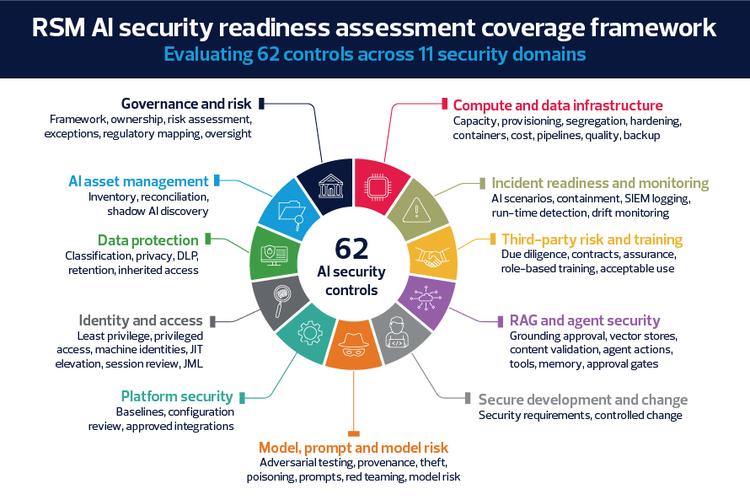
The RSM AI security readiness assessment evaluates 11 security domains that influence your organization’s ability to adopt, govern and scale AI securely. Together, these domains provide a comprehensive view of the people, processes and technologies that support AI initiatives while managing risk.
Rather than focusing solely on individual AI tools or models, the assessment examines the underlying capabilities needed across the enterprise. RSM evaluates governance, data, security, operational and infrastructure controls to identify readiness gaps, establish deployment criteria and prioritize corrective actions to scale AI responsibly.
How RSM evaluates AI security readiness
The assessment identifies security gaps, establishes practical decision criteria and defines the monitoring actions needed to scale AI safely.
Build a defensible path to secure AI adoption
As AI initiatives advance, leaders need to understand whether security capabilities are keeping pace with new risks and requirements. The RSM AI security readiness assessment provides an objective view of your organization’s preparedness, helping you make informed decisions about AI adoption and risk.
Turn AI security readiness into action
Over eight to 10 weeks, RSM evaluates your organization’s AI security readiness and translates the findings into actionable priorities. The assessment is designed to help your organization:
- Understand your current security posture before significant AI investment, development or deployment.
- Identify critical gaps and exposure related to shadow AI, sensitive data and unmonitored AI activity.
- Define security criteria for AI initiatives across pilots, development, acquisition and production deployment.
- Create a consistent approach to AI security decisions, one that supports architecture reviews, procurement, approvals and ongoing oversight.
- Prioritize security improvements across controls, monitoring, compute readiness and data foundations.
What you receive: RSM provides a security-readiness position, prioritized findings and a sequenced roadmap for addressing identified gaps. These deliverables help determine which initiatives are prepared to proceed, where additional safeguards are needed and how security capabilities should evolve as AI use expands.
Ready to advance AI securely?
Connect with RSM’s AI advisors to evaluate your organization’s security readiness and identify the actions you need to support AI adoption at scale.